Stomach drops. “But where are you really from?”
"I love the idea of gentle parenting. But it doesn't sound like how I was raised, and I wasn't raised badly."
Almost every parenting program available today is built on the same foundation: Western, individualist attachment theory, developed largely from research on white, middle-class, nuclear-family households in the UK and US in the mid-twentieth century. The science inside it is real, children genuinely do need a secure base, attuned caregiving, and repair after rupture. That part isn't in question.
What's in question is what happens next: most programs quietly assume that the way those needs get met, one primary caregiver, a nuclear household, praise-and-consequence discipline, independence prized above interdependence, is the only correct delivery mechanism. For many of the families we work with, that assumption doesn't match how they were raised, how their own parents were raised, or the values they're actively trying to pass on.
Roots vs Routes was built because "choose attachment science or your culture" is a false choice. This program teaches the science in full, and teaches it alongside, not instead of, the cultural inheritance you're bringing into the room.
Throughout this program, "Roots" refers to what you've inherited, the parenting wisdom, values, and practices carried through your family and culture, often across migration, displacement, or generations of adaptation. "Routes" refers to the path forward you're actively choosing for your own family, which parts of that inheritance you're keeping, which you're consciously reworking, and which new practices you're adding, informed by developmental science. Neither is more "correct" than the other. The work is in the weaving.
This program deliberately does not assume a single "non-Western culture" to speak on behalf of. The families we work with come from vastly different backgrounds, and this program is designed to be filled in with your specific culture, migration story, and family history, not a generic stand-in for it. Where we use examples, they're composites drawn from patterns across many families, not any one person's story, and they're offered as illustrations of theprocess of weaving roots and routes together, not as a script to copy.
This program is neuroaffirming and non-behavioural throughout. You won't find reward charts, sticker systems, or compliance-based discipline strategies here. Those approaches, whatever culture they come from, tend to teach children to manage adult approval rather than to understand or regulate their own internal states. What you will find is a genuine, side-by-side exploration of what secure attachment requires, and how your own family and culture already offer real, valid ways of providing it.
Orientation: why this program holds two things at once
The parent's own story, before the child's
The developmental science, decoupled from its cultural packaging
Regulation, respect, and discipline: held together, not traded off
Racial socialisation as part of secure attachment, not separate from it
Beyond the parent-child dyad
Navigating systems, and bringing it all together
This session sets the frame for everything that follows. We're not here to decide whether attachment theory or your cultural inheritance is "right." We're here to get specific about what your child actually needs developmentally, and specific about what your family and culture already offer. So you can see, clearly, where they already agree, and where a genuine conversation is needed.
Before we talk about how to parent your child, this session asks you to look at how you were parented. And by whom. For many families, "how I was raised" isn't a single, tidy story. It might involve a grandmother who did the daily caregiving while parents worked, a home country left behind, a language spoken to elders but not to children, or a generation that survived under conditions where attunement was a luxury safety didn't always allow for.
This isn't an exercise in judging the past. Many parenting practices that get labelled "harsh" by modern Western standards were survival-adapted responses to real conditions, displacement, poverty, racism, war, not failures of love. Naming that clearly is part of Roots. Choosing, now, with more safety and more information available to you, what you want to carry forward and what you want to do differently, that's Routes.
"My mum raised five of us while working nights. There wasn't time for long conversations about feelings. There was 'eat, sleep, go to school, and don't shame this family.' I used to think that meant she didn't do attachment. Now I think she did it through consistency and through never once leaving. I'm trying to keep that consistency and add the conversation part in, not replace what she gave me."
This session teaches the actual developmental science, clearly, and in full, while separating out what's genuinely universal from what's simply how it was first written down in a particular cultural context.
This is often the session parents have been waiting for, and the one where the tension feels most real. Neuroaffirming, non-punitive approaches to behaviour are usually presented as the opposite of respect-based, elder-honouring, obedience-valuing parenting norms common in many cultures. This session works from a different premise: that both are pointing at something true, and the actual disagreement is narrower than it first appears.
Where this program does take a clear position, consistent with the rest of Anoshe's practice: children's dignity isn't up for negotiation, and shame-based or humiliation-based responses to a child's distress are not recommended, in any cultural form. That's a safety principle, not a cultural preference. Within that boundary, there is genuine room for your family's own values about respect, hierarchy, and the role of extended family in discipline.
A child's sense of safety in the world isn't only built at home. For children who will encounter racism, mispronounced names, or questions about where they're "really" from, part of a secure base is a parent who has already had these conversations with them, before the world forces the conversation to happen unprepared.
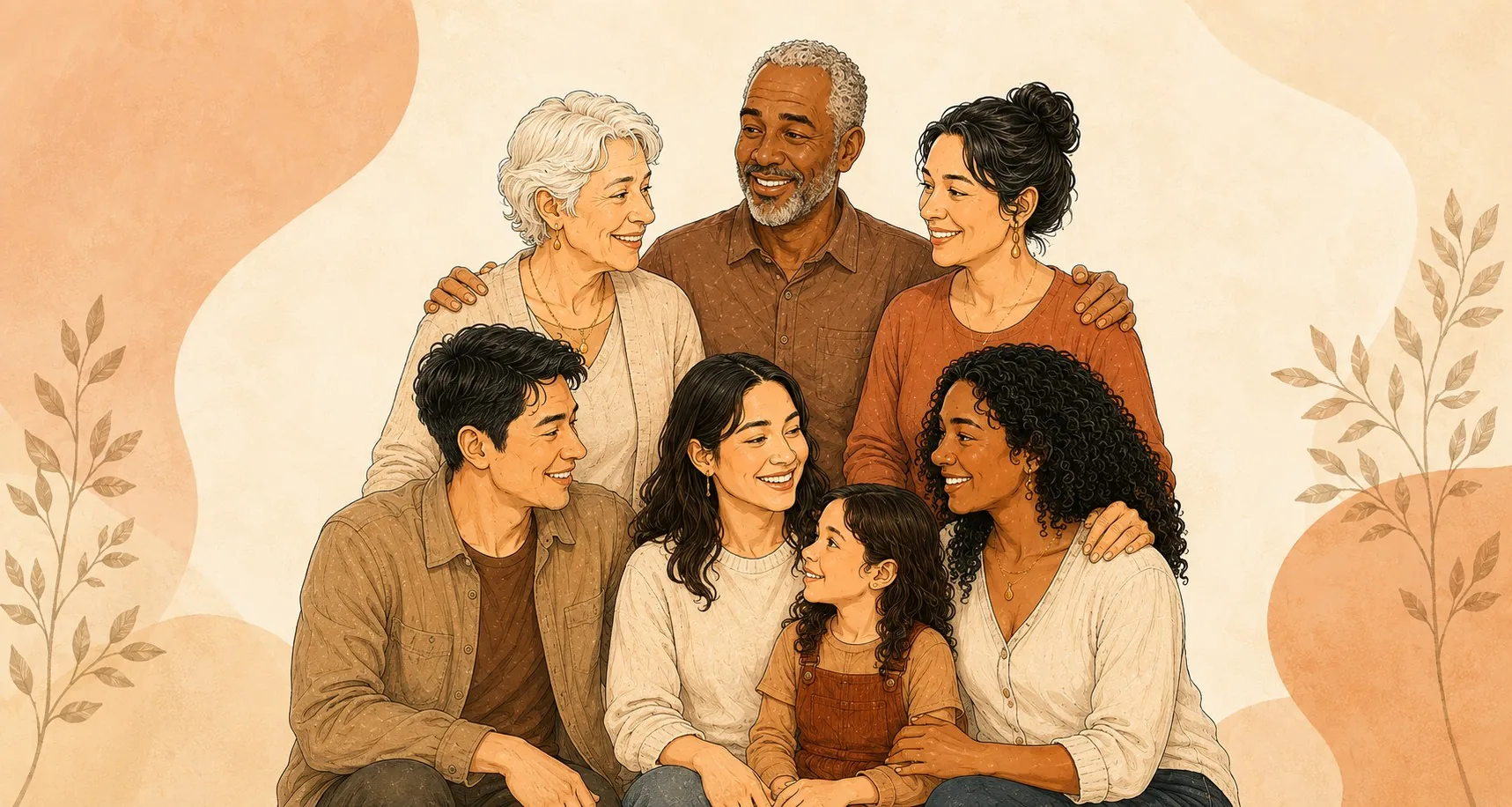
Much attachment literature is written as though the relevant relationship is between one child and one (or two) primary caregivers. For many families, the actual secure base has always included grandmothers, aunties, older cousins, and community elders as central, not supplementary, attachment figures.
This closing session has two parts: practical guidance on navigating schools, healthcare, and other institutions as a family of colour, and a final integration exercise that asks you to put your own Roots-and-Routes map into words, not ours.
Schools, GPs, and mental health systems don't always recognise communal caregiving, non-Western discipline norms, or culturally specific parenting knowledge as legitimate, sometimes flagging them, incorrectly, as concerns. Part of this session covers what to expect, how to advocate for your family's approach being understood rather than pathologised, and when and how to bring in support (including Anoshe's own clinicians) as an ally in those conversations rather than another system to manage alone.
The session material, the exercises, the frameworks, and the guided work on your own family's map, is delivered live across the seven sessions. Tell us a little about your family and we will send you dates, pricing and what to expect.
Session outlines are shown here. The workbook, exercises and facilitated discussion are part of the program itself.
Our model is published, read the full framework here.
Everything on this site is built on our published model. Read the full framework here.