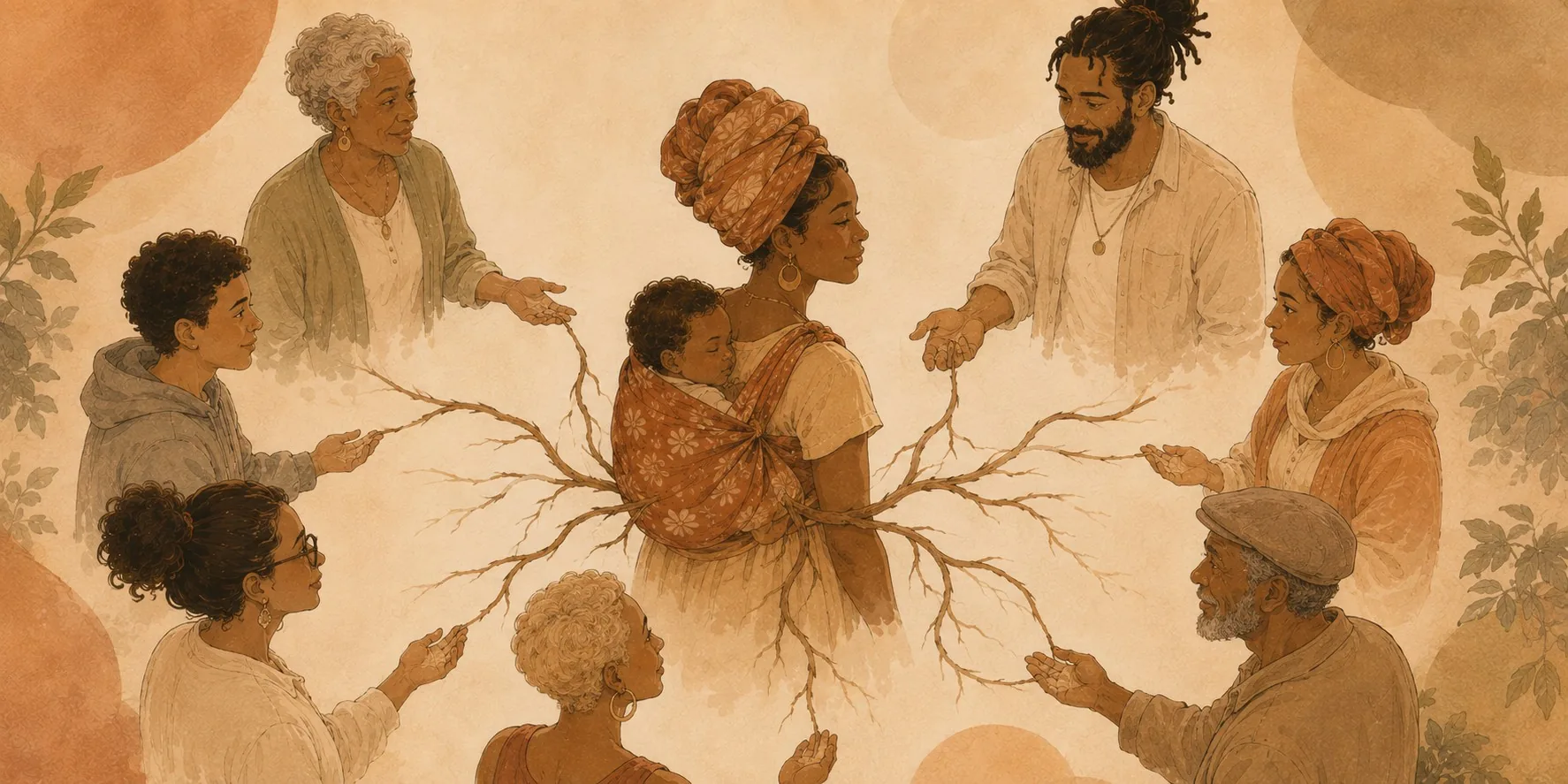
Attachment research has never actually supported a single-caregiver, nuclear-family model. It was assumed to. This is the evidence underneath Roots vs Routes Session 3 and Held.
Popular attachment advice often implies that security comes from one consistent primary caregiver, in a nuclear household, with independence as the developmental goal. The actual research base doesn't say this. And in several cases, its foundational studies were cross-cultural and communal-caregiving from the very start.
This page lays out that evidence directly, so the claim isn't left as an assertion. It's the reference underneath Roots vs Routes Session 3, Attachment Without the Import, and Held's caregiving approach.
Mary Ainsworth's original observational fieldwork, the study that produced the first attachment classifications, before the later Baltimore study most people know, was conducted among Ganda mother-infant pairs in Kampala in 1954 to 1955. The methodology now treated as the gold standard began as cross-cultural research, not a Western model later exported.
Ainsworth, Infancy in Uganda (1967); Bretherton, The Origins of Attachment Theory (1992)Mesman, van IJzendoorn, and Sagi-Schwartz's 2016 update to the field's standard reference, the third edition of the Handbook of Attachment, reviewed the accumulated cross-cultural evidence since the original 1988 meta-analysis and reached the same conclusion with a much larger evidence base: secure attachment as the most common pattern across tested cultures, with greater variation among families within a country than between different countries.
Mesman, van IJzendoorn & Sagi-Schwartz, in Cassidy & Shaver (Eds.), Handbook of Attachment, 3rd ed. (2016); originally Van IJzendoorn & Kroonenberg (1988)Decades of research on Israeli kibbutz-raised children, including communal sleeping arrangements away from parents, found infants formed genuine, secure attachments to mother, father, and a dedicated caregiver (the metapelet) simultaneously. Security tracked with consistency and warmth of care, not with which specific arrangement delivered it.
Sagi et al. (1985, 1994); Aviezer, van IJzendoorn, Sagi & Schuengel, Children of the Dream Revisited (1994)A 2024 paper in Child Development Perspectives argues attachment theory has been "overly narrow," built on observations of Euro-American nuclear families, and proposes it be expanded around three sources of resilience long practiced in Black families: preparation for bias ("The Talk"), extended caregiving networks (fictive kin, natural mentors, spiritual community), and positive racial-ethnic identity. It also confirms differences once attributed to ethnicity are more accurately explained by socioeconomic stress.
Stern, Coard, Barbarin & Cassidy, Child Development Perspectives (2024); building on Bakermans-Kranenburg, van IJzendoorn & Kroonenberg (2004)A dedicated chapter on attachment in multi-caregiver contexts in the current Handbook of Attachment, and a 2021 paper on "early attachment networks to multiple caregivers," both describe infants forming an organised hierarchy of several attachment relationships at once. A grandmother, an auntie, or a co-parent isn't competing with a "real" attachment figure; each can be a genuine one.
Howes & Spieker, in Cassidy & Shaver (Eds.), Handbook of Attachment, 3rd ed. (2016); Dagan & Sagi-Schwartz, New Directions for Child and Adolescent Development (2021)Fieldwork among Aka forager infants found an average of 21 different caregivers across kin and non-kin, some of whom function as genuine attachment figures in their own right. Barry Hewlett's earlier work with Aka fathers found similarly high rates of direct paternal infant care, among the highest recorded in any studied society. High father involvement and communal caregiving aren't a departure from what secure attachment requires, in these populations, they're the norm it was built on.
Meehan, Quinlan & Malcom, American Journal of Human Biology (2013); Hewlett, Intimate Fathers (1991)The studies above are genuinely cross-cultural, but most of them aren't diaspora-centred, Uganda and the Aka are continental African fieldwork, not the Black and Caribbean diasporic experience most of our families are actually living. This is the literature that is, foundational studies alongside work as recent as 2024.
Patricia Hill Collins' concept of "othermothers" describes a recognised system within Black communities, particularly in the US, where women who aren't a child's biological mother, grandmothers, aunts, neighbours, church elders, take on real, expected responsibility for childrearing. It's documented as a deliberate, functional practice, not a deficit version of the nuclear family.
Hill Collins, Black Feminist Thought (1990, rev. 2000)Carol Stack's ethnographic study of an African American community found dynamic, highly structured kinship-exchange networks, child-rearing, resources, and support flowing across households, not confined to a single nuclear unit. It directly challenged the "unstable Black family" narrative dominant in policy research at the time, documenting resilience where deficit was assumed.
Stack, All Our Kin (1974)Edith Clarke's foundational study of Jamaican family life documented matrifocal households, often multigenerational, often without a resident father, as a coherent, long-standing family form in the Caribbean, not a broken version of a nuclear ideal. This structure persists among Caribbean diasporic families well after migration.
Clarke, My Mother Who Fathered Me (1957)A 2020 review in the Annual Review of Anthropology examined Black Caribbean communities living in the UK, US, and Canada, arguing that caregiving in these families routinely extends well beyond one household, shaped by, not undermined by, transnational labour migration. It challenges research models built around a single bounded household as poorly suited to how the majority of the world's families actually organise care.
Nelson, Beyond the Household: Caribbean Families and Biocultural Models of Alloparenting, Annual Review of Anthropology (2020)A 2014 paper in the Journal of the National Black Nurses' Association argues clinical intake and case documentation need a "culturally appropriate pedigree nomenclature" that recognises fictive kin and othermothers as real caregiving roles, not an informal workaround to be translated into standard family-tree categories that don't fit.
Spruill, Coleman, Powell-Young, Williams & Magwood, Journal of the National Black Nurses' Association (2014)This page is the reference underneath two programs already built on it.
"The science was never the obstacle. It was always broader than the version most families were handed."
Everything on this site is built on our published model. Read the full framework here.